Introduction to HackerRank Library
Last updated: March 30, 2026
The HackerRank Library provides ready-to-use questions for tests and interviews. It includes:
Questions curated and maintained by HackerRank.
Questions created by you and other team members in your organization.
Accessing the Library
To access the library:
Log in to your HackerRank for Work account using your credentials.
Go to the Library tab.
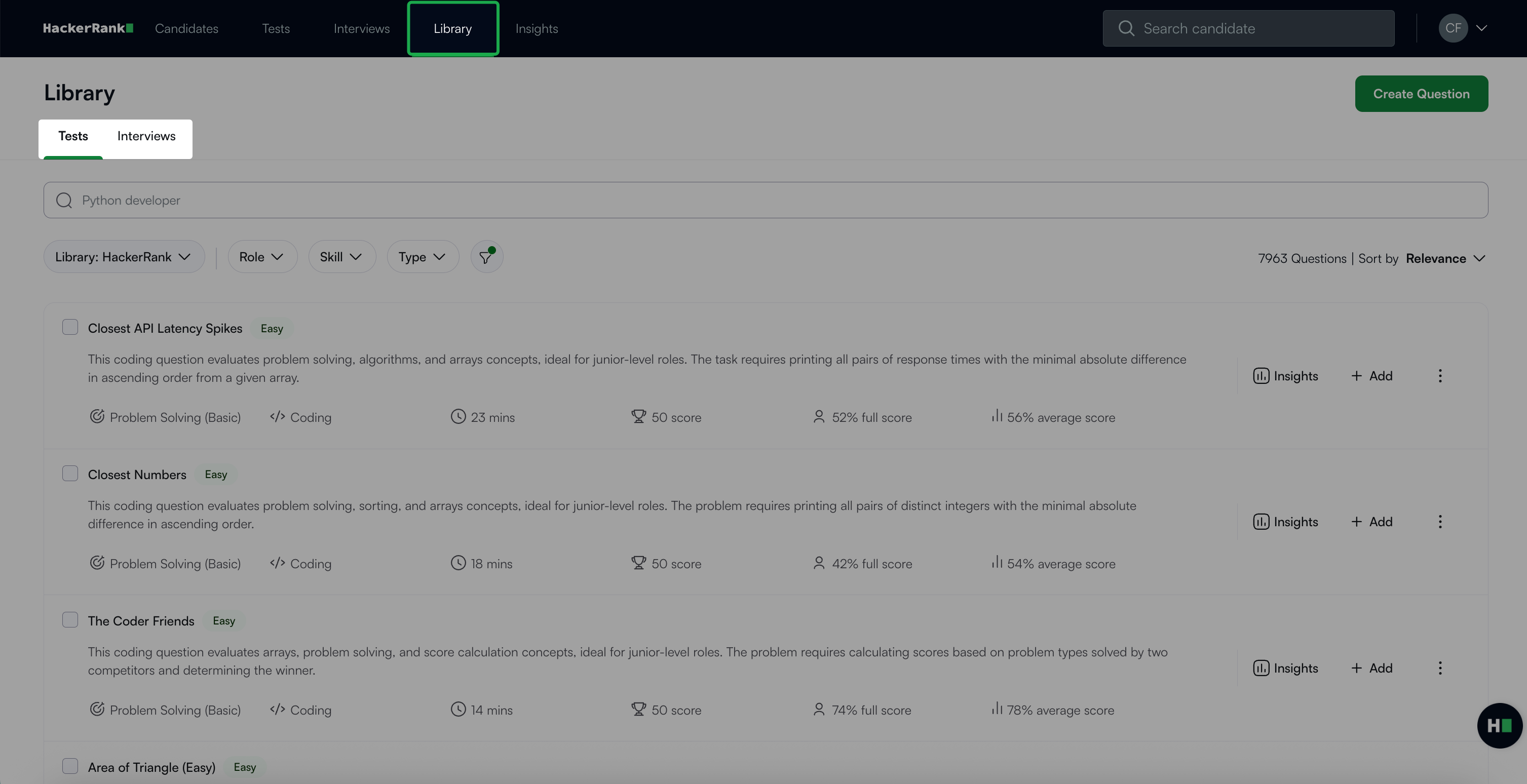
The Library contains two sub-tabs:
Tests: Displays questions you can add to test assessments.
Interviews: Displays questions you can add to interview templates.
Each question includes details such as the title, description, difficulty level, assessed skills, question type, duration, full score, the percentage of candidates who achieved the full score, average score percentage, and more.
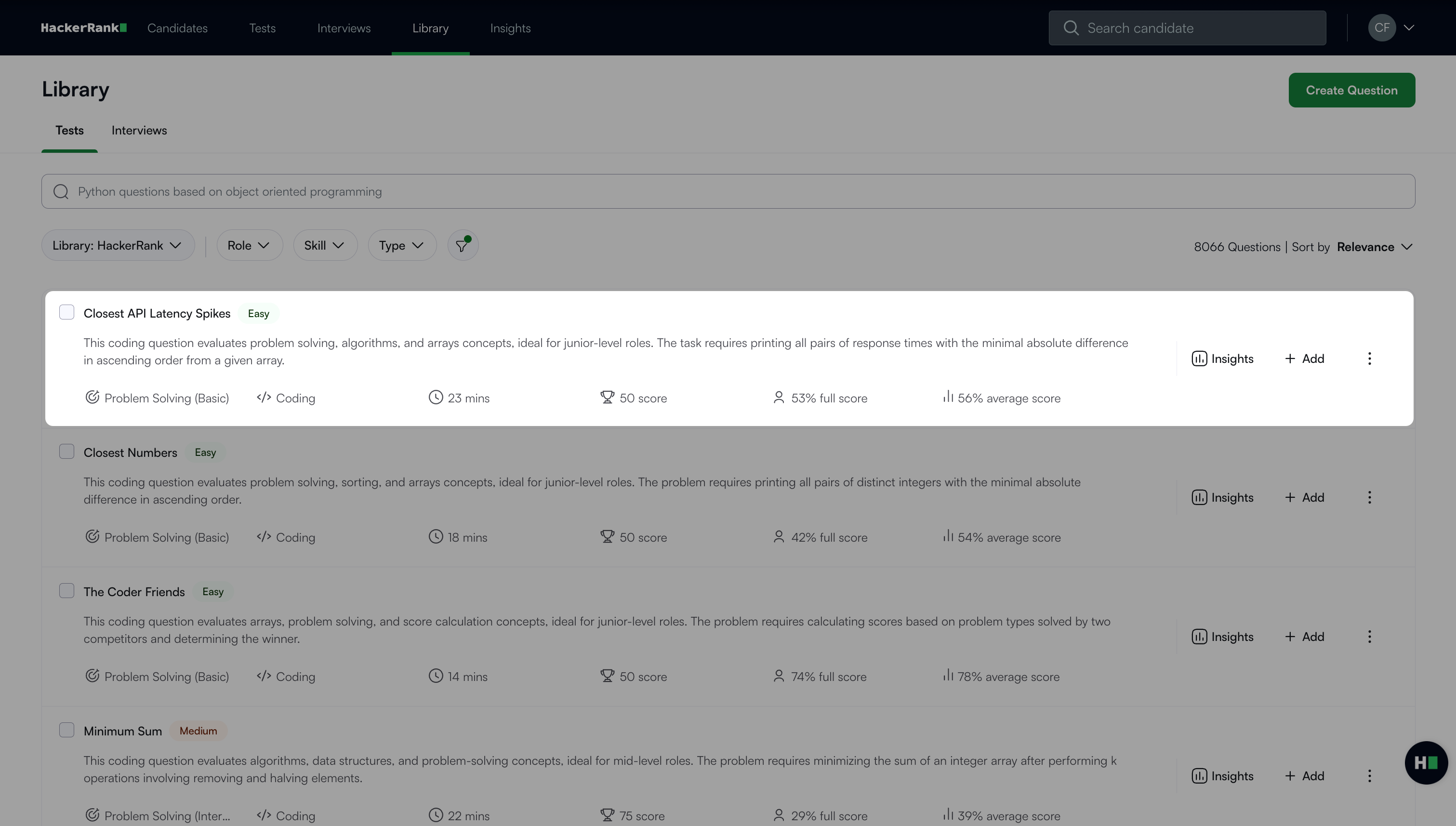
Question sources
Use the Library dropdown to select the source of questions:
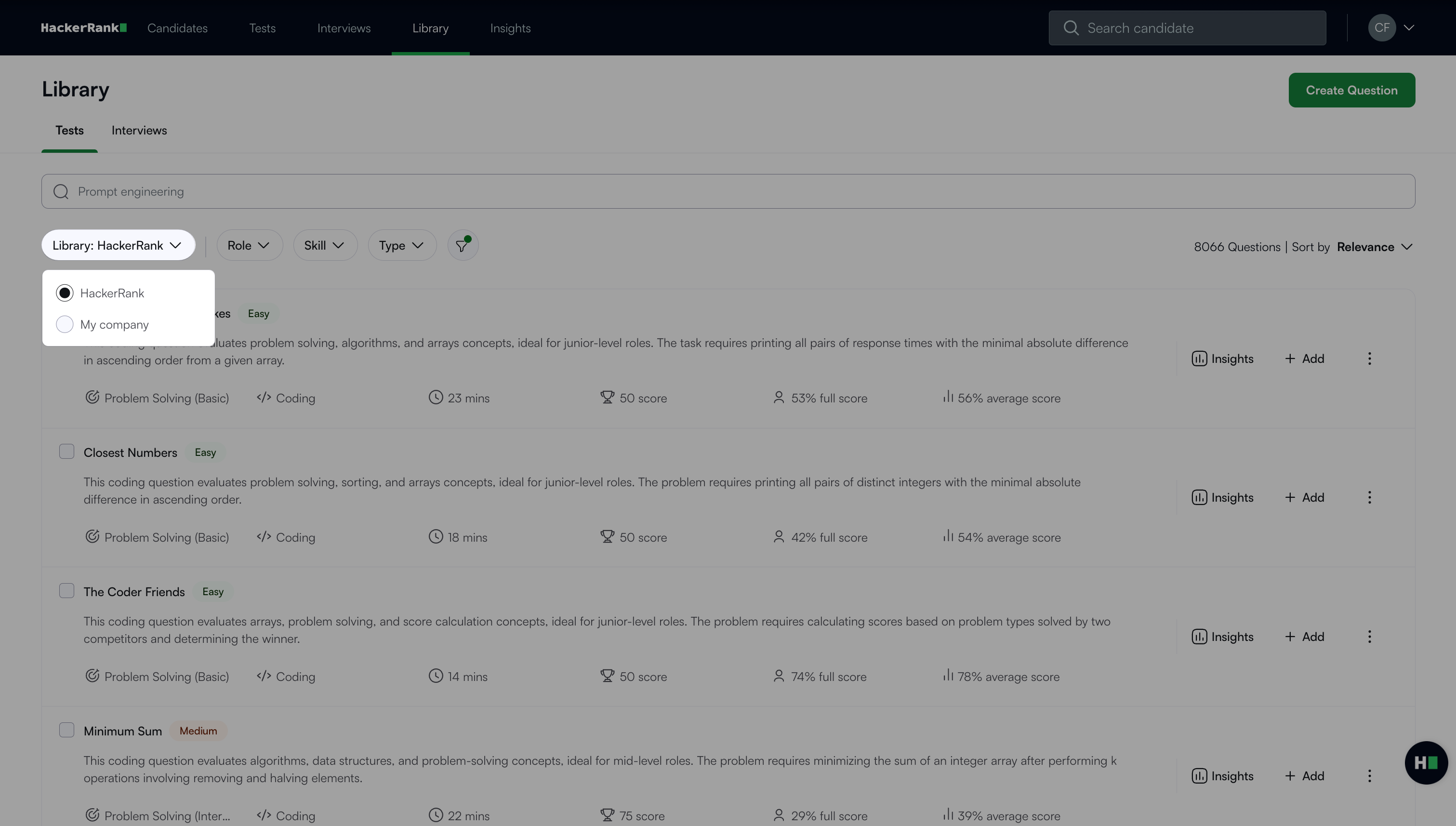
HackerRank: Questions curated and maintained by HackerRank
My company: Questions created by you and other team members in your organization.
The total number of available questions appears in the upper-right corner.
Note:
For information about supported question types, see 📄 Question Types in HackerRank.
You can refine your question results using the search, sort, and filter options.
The library selection persists based on the last selection. For example, if you select My Company and navigate away from the Library, the same option remains selected when you return. The last selected library also persists in the Add Question flow from a Test or Interview.
Test question actions
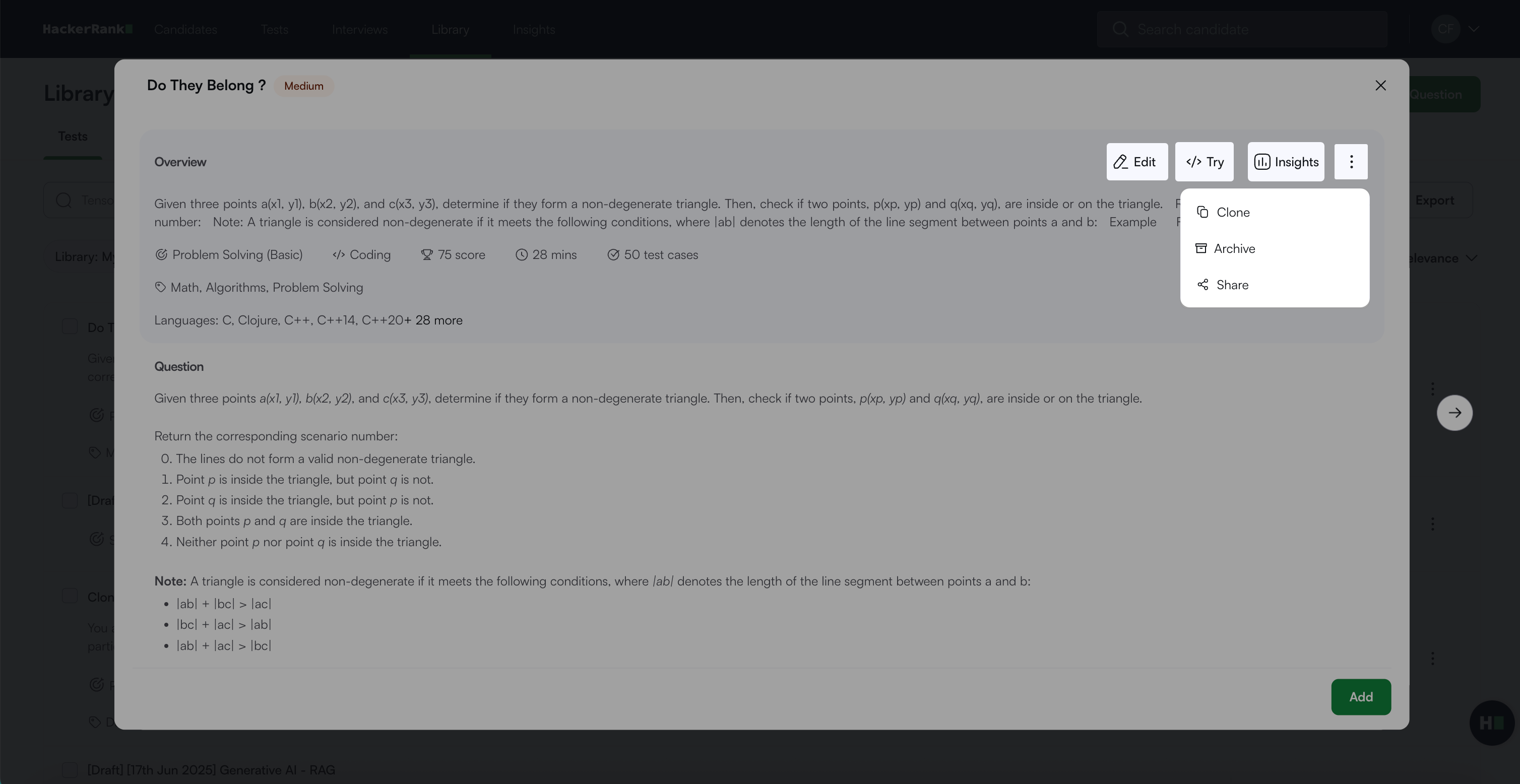
When you select a question in the Tests tab, the available actions depend on the question source as shown in the table below.
HackerRank questions:
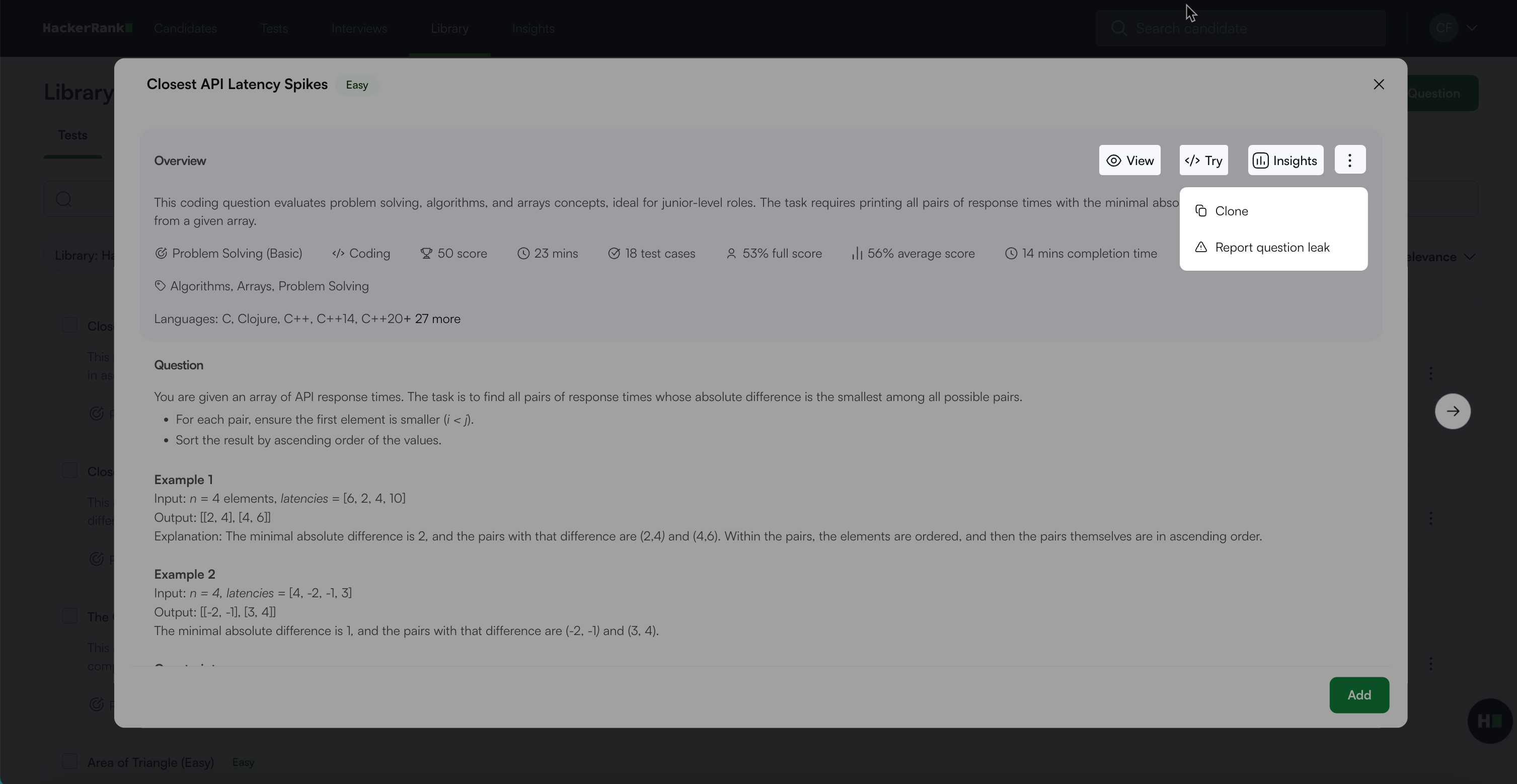
My company questions:
Interview question actions
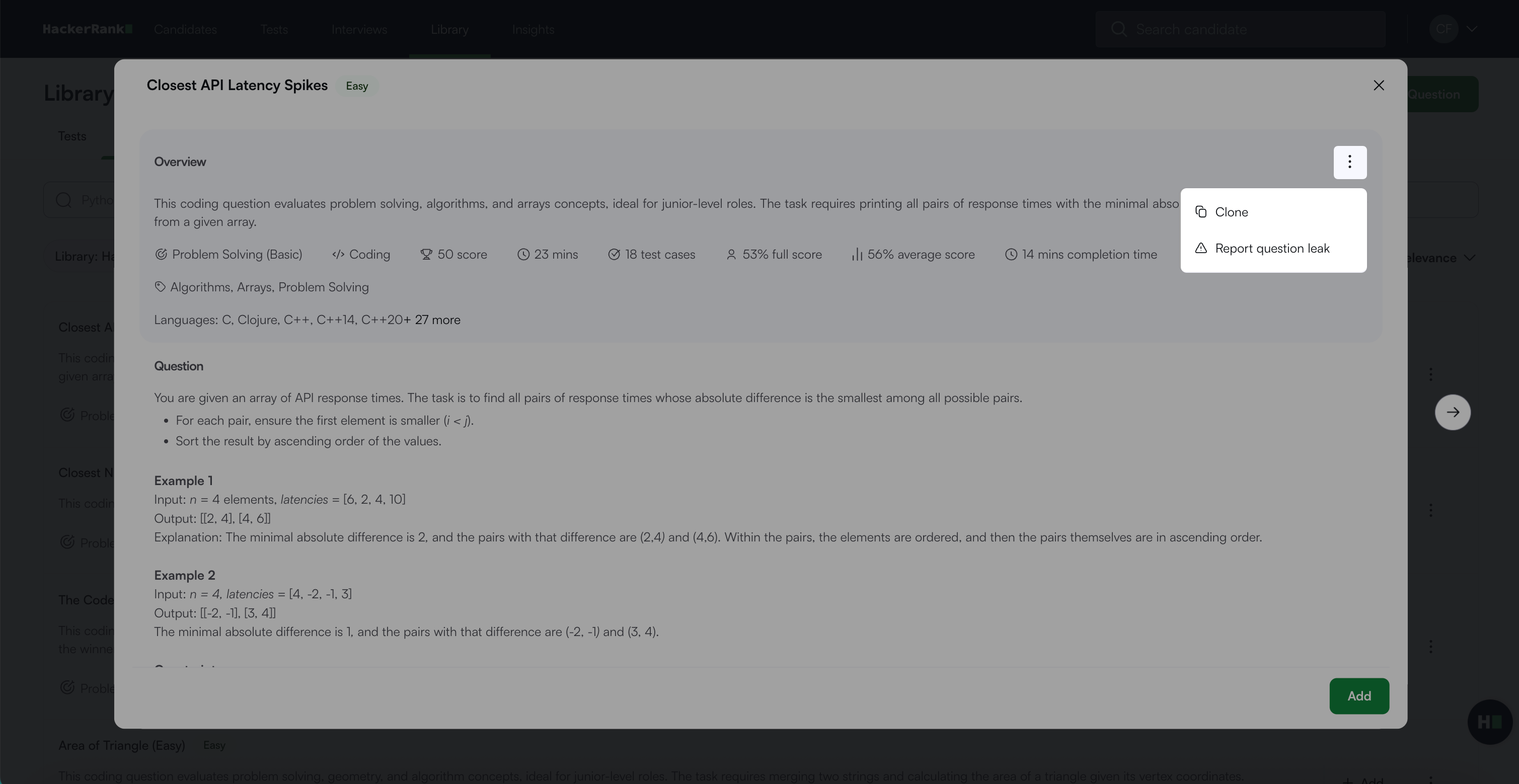
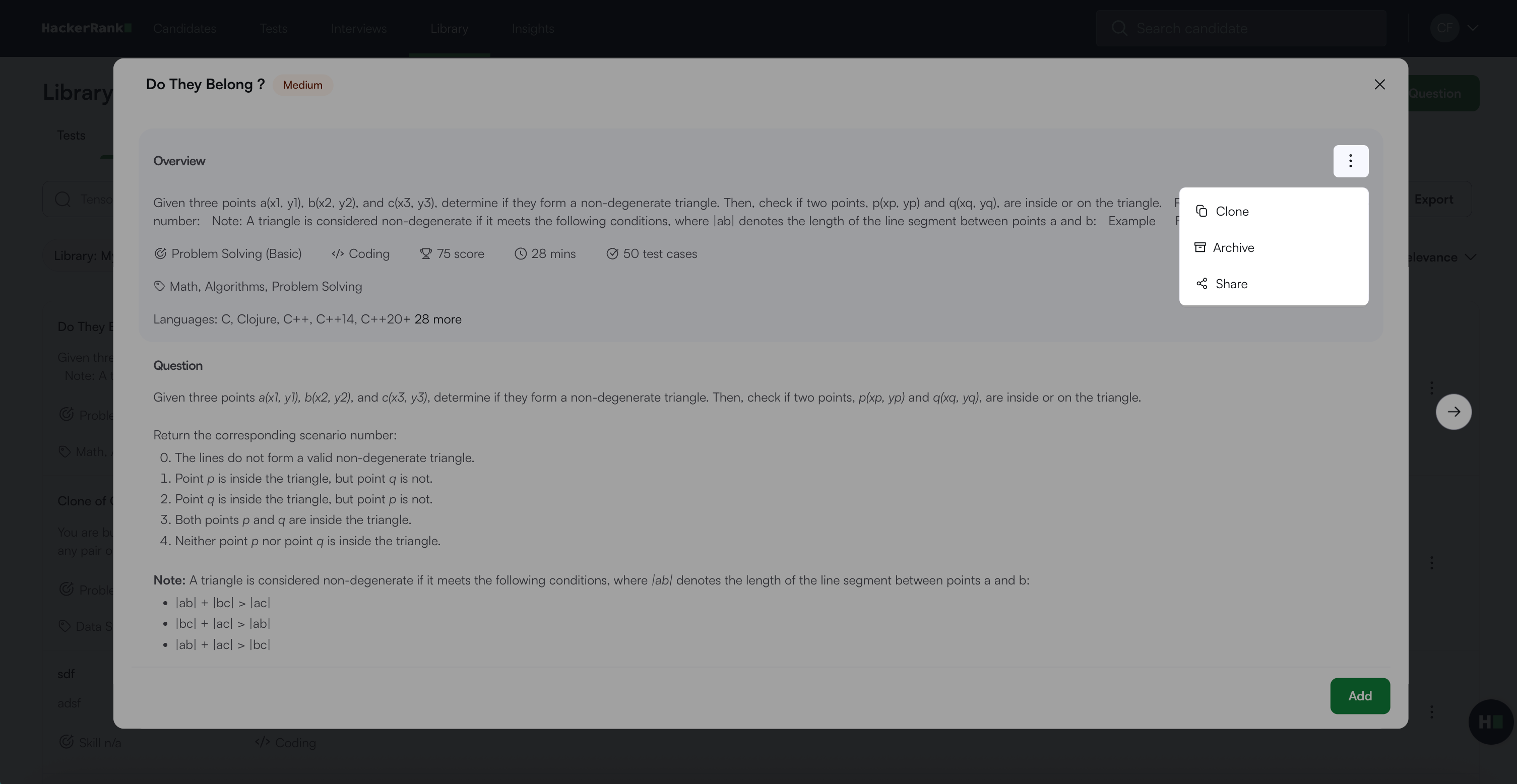
When you select a question in the Interviews tab, the available actions depend on the question source as shown in the table below.
HackerRank questions:
My company questions:
Searching, sorting, and filtering questions
You can search, filter, and sort questions to quickly find and manage the ones you need.
Search: Use the search bar to find the questions. You can enclose a search term in quotation marks (
" ") to perform an exact match search. For example,“Questions".Sort: By default, questions are sorted by Relevance. Use the Sort by dropdown to reorder questions by:
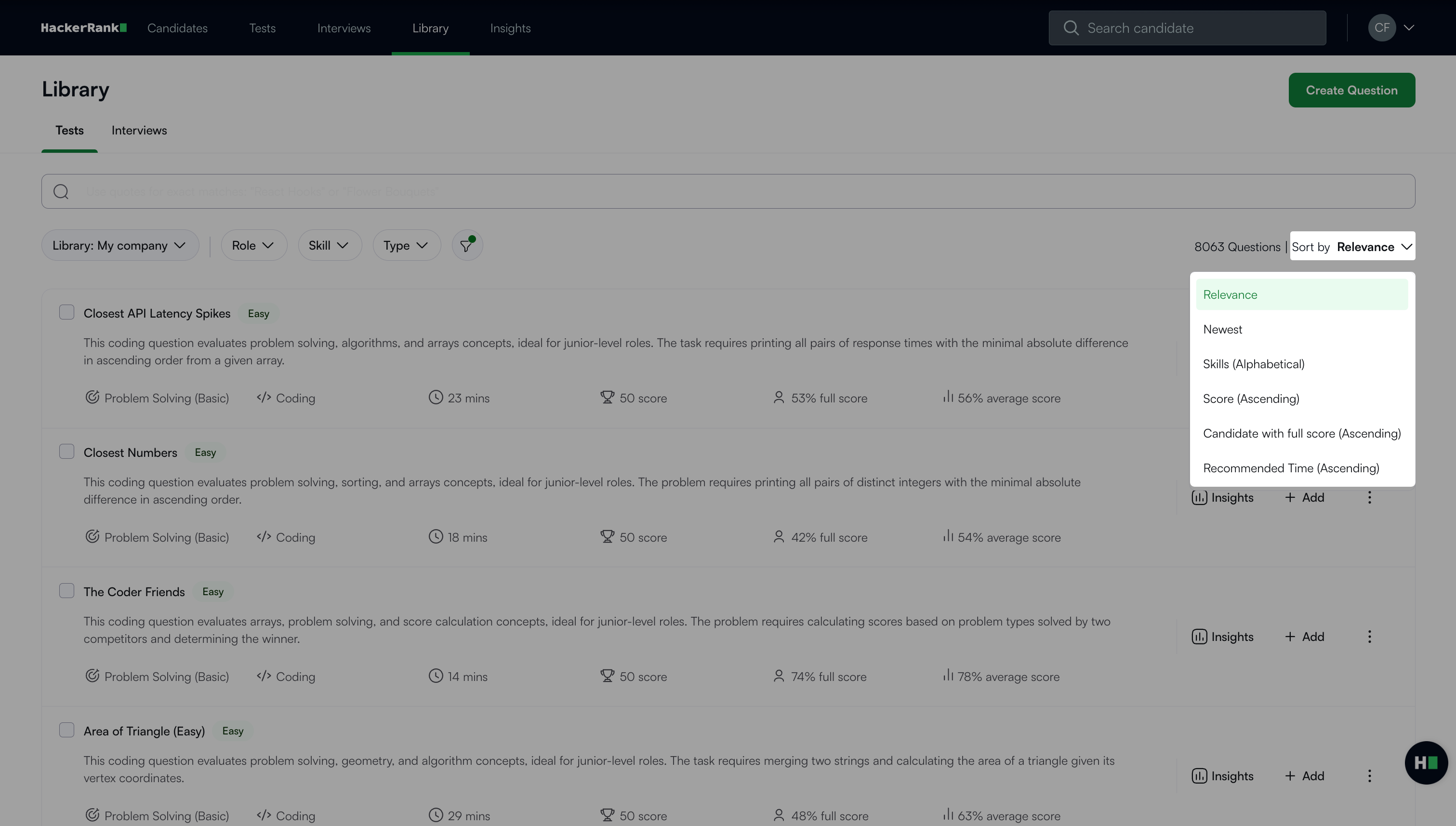
Newest
Skills (Alphabetical)
Score (Ascending)
Candidates with full score (Ascending)
Recommended time (Ascending)
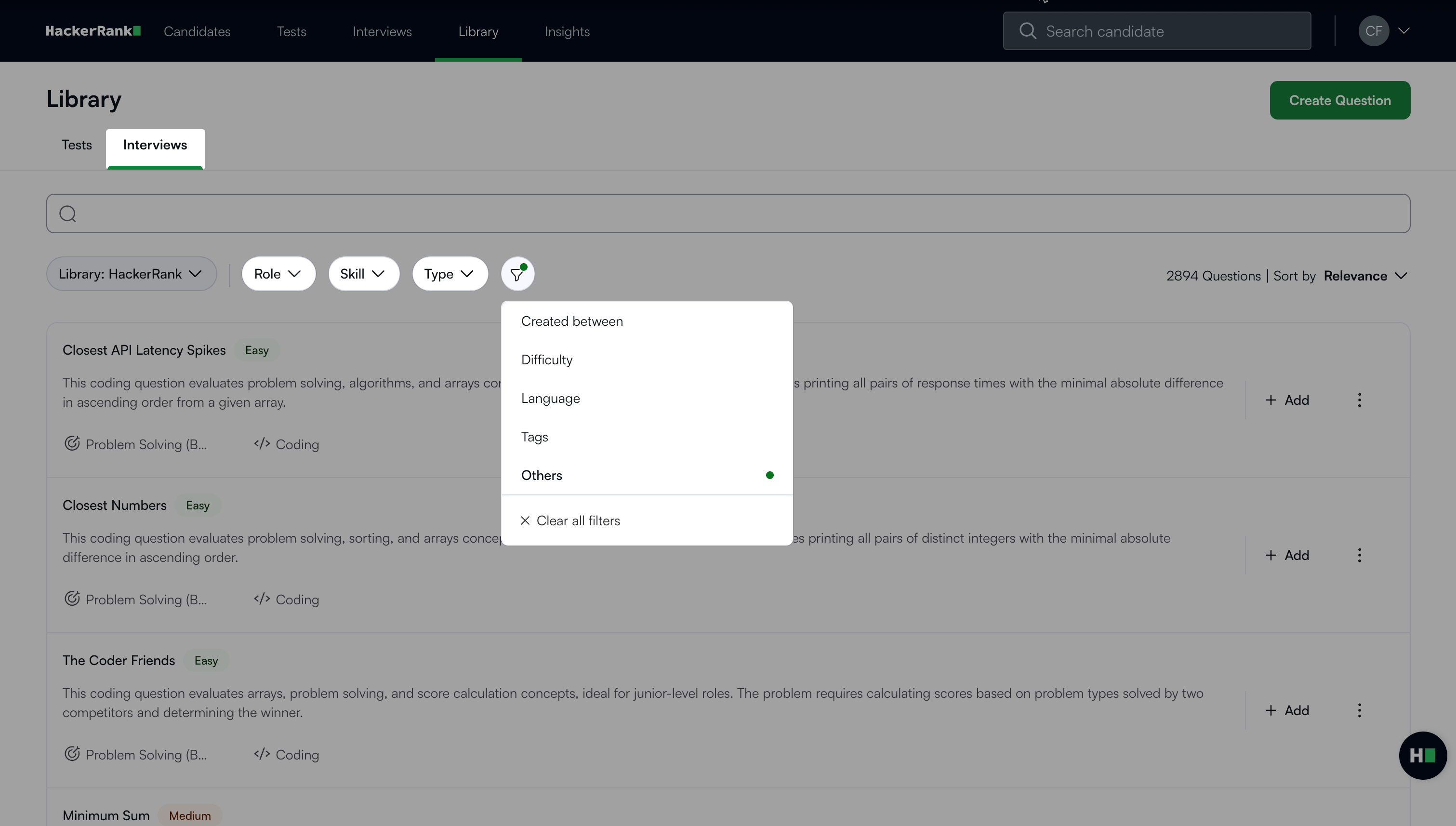
Filters: You can filter questions by the following attributes:
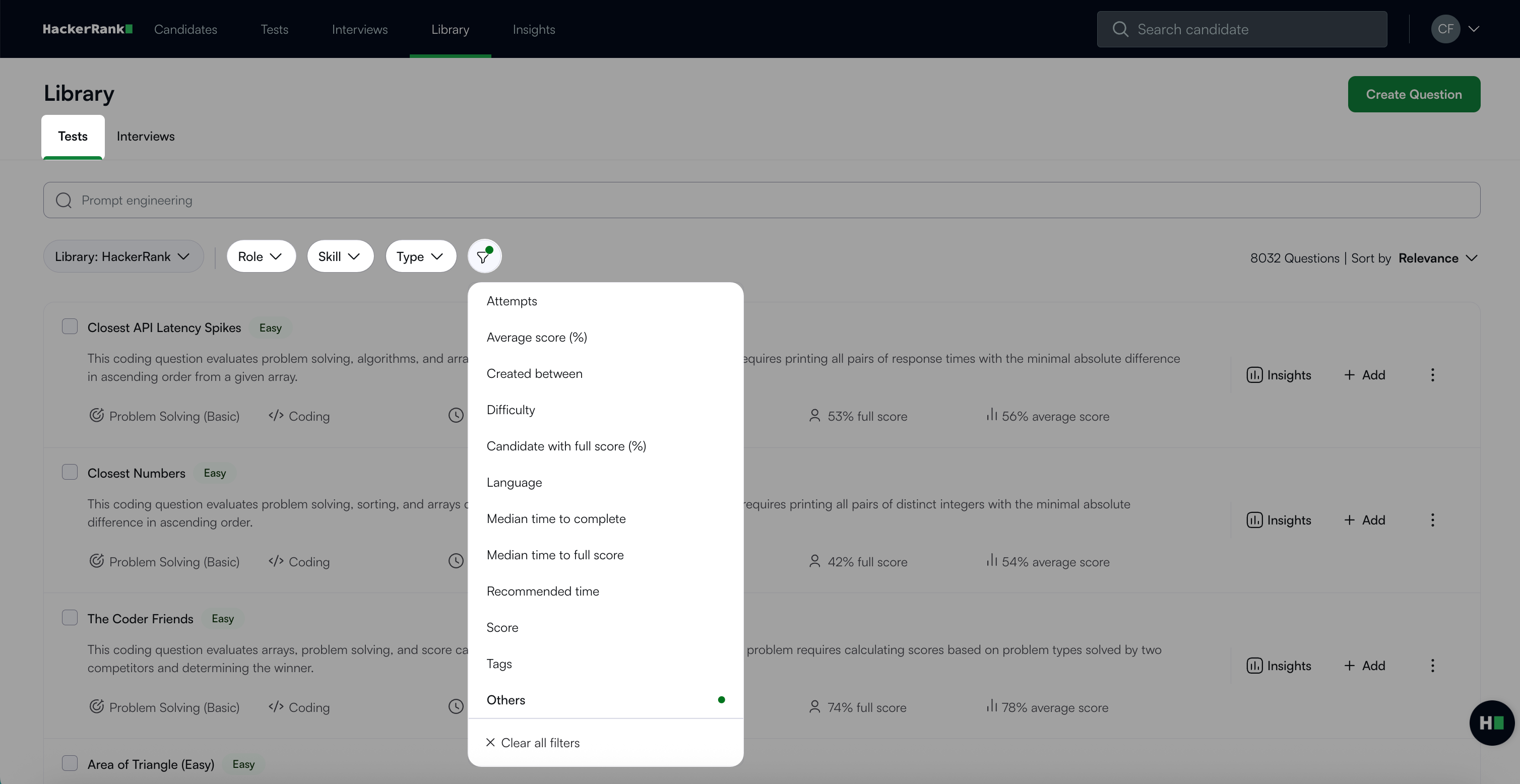
Role: Questions mapped to a selected job role.
Skill: Questions that assess specific skills.
Type: Questions by type, such as Coding, Data Science, Whiteboard.
Attempts: Number of candidate attempts (Only applies to Test questions).
Average score (%): Average score of candidates in percentage (Only applies to Test questions).
Created between: Date range when the question was created.
Difficulty: Difficulty level, such as Easy, Medium, Hard.
Candidates with full score (%): Percentage of candidates who achieved a full score (Only applies to Test questions).
Language: Programming language, such as Python, Java, C++.
Median time to complete: Median time candidates take to finish a question (Only applies to Test questions).
Median time to full score: Median time candidates take to achieve a full score (Only applies to Test questions).
Owner: Question owner (Applies when the source is My company).
Recommended time: Suggested time to solve the question (Only applies to Test questions).
Score: Maximum score assigned to the question (Only applies to Test questions).
Tags: Questions with selected custom or system tags.
Archived: Displays all archived questions (Applies when the source is My company).
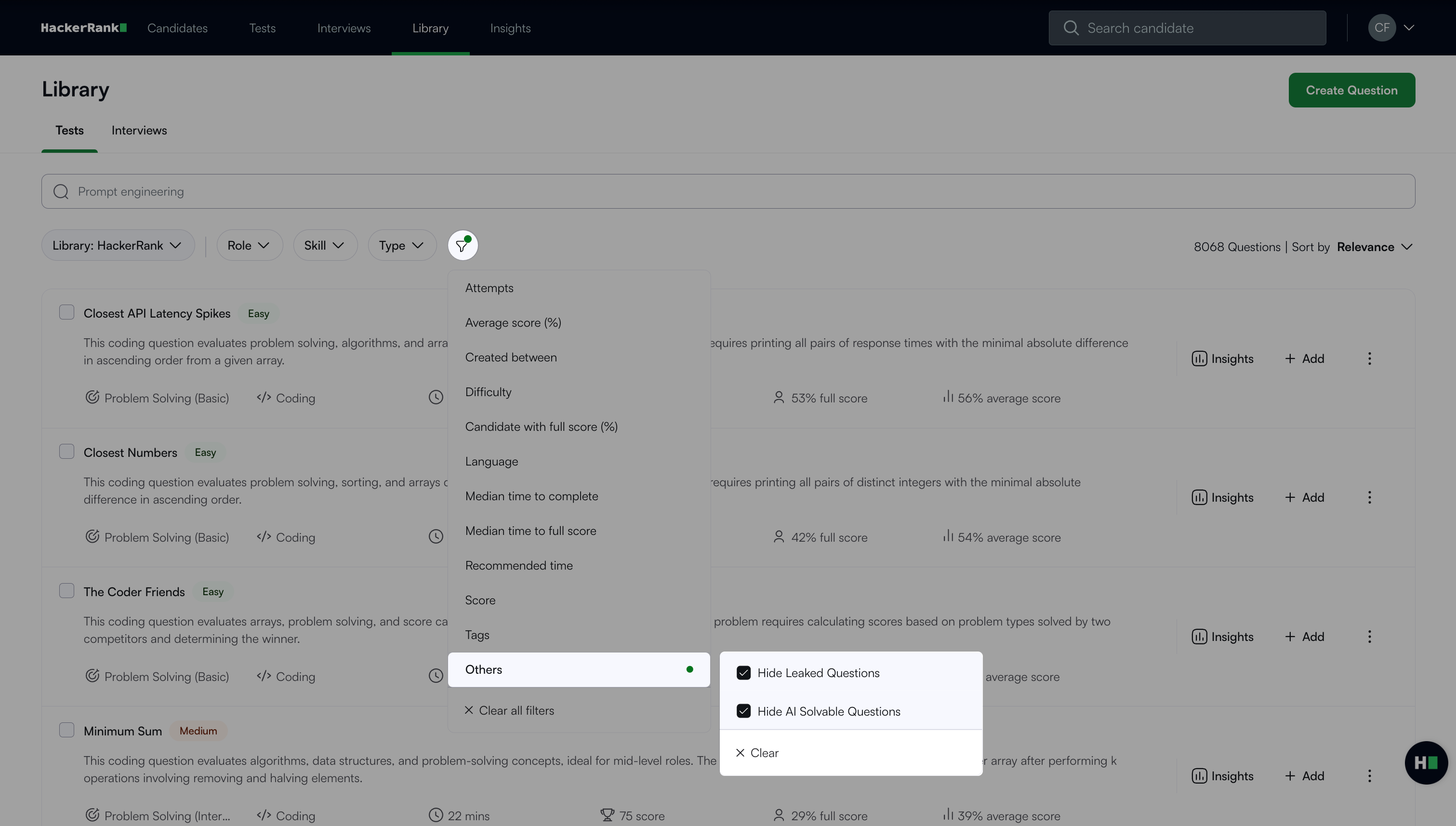
Others: Additional filters, such as:
Leaked Questions: Questions marked as leaked.
AI Solvable Questions: Questions identified as solvable by AI tools.
Note:
Leaked Questions and AI Solvable Questions are hidden by default. To display them, uncheck their checkboxes.
You can export test and interview questions from the Library to a CSV file. For more information, see 📄 Export Questions.